
DNA Cousin Quest
|
|
DNA Cousin Quest Visualize shared DNA in your family tree |
|
|


Adjust
tree

 Instructions
 Hide
Hide
DNA Cousin Quest is a visual tool to compare the DNA you share with a relative to a statistical average. Adjust the numbers of descendants in both your branch, and their branch of the family tree, until the shared DNA value comes within range.
Enter the actual total Shared DNA, in centimorgens, you share with your relative and click Enter.

This value is provided by your genetic testing company for each of your matches. Be sure to enter the total shared DNA, and not the longest segment length. As an example, 64cM is the total shared DNA for this match.

Use the + or - buttons in the Common Ancestor node to add or subtract descendants on each of the two branches of the family tree. It helps to refer to the pedigree chart of the person you match.
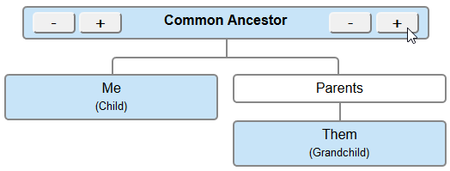
As you add or subtract descendants, your shared DNA will move
from
Out of Range
to In Range.
This represents a possible relationship.
Here the actual value of 64cM is within range of 0cM to 139cM, and close to the average of 57cM:
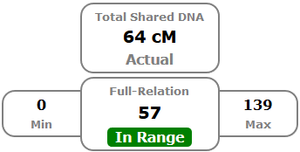
The numbers for comparison are from the Shared cM Project by Blaine T. Bettinger. They were collected from a large number of people who determined their actual relationships. The middle number is the average shared DNA for a given relationship. The minium and maximum values define a range where actual relationships fell.
More than one relationship is possible. This is because different people who are related share different amounts of DNA and the ranges overlap. Add or subtract decendants to find the closest match with your value. Use the average as a guide only. A value somewhere between the minimum and maximum is more likely.
It is more difficult if your match does not provide a pedigree chart, or either of your charts don't go back far enough. You can still estimate a relationship to a common ancestor when you know only one lineage. Add descendants to the known branch of the tree. Then add descendants to the unknown branch until the average shared DNA approximates your actual shared DNA.
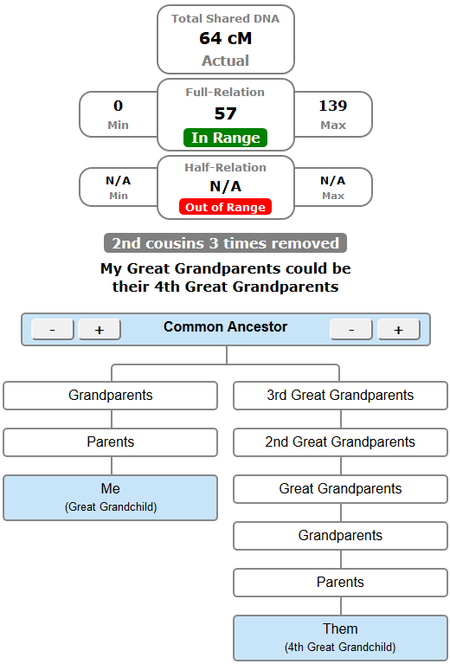
By adjusting the number of descendants in each branch, you can visualize how a distant cousin might fit in your family tree. For example, here the tree shows 2nd cousins 3 times removed. With 64cM of shared DNA, it's possible that my great grandparents could be their 4th great grandparents. This is consistent with "2nd Cousin - 4th Cousin" indicated by the genetic testing company.
Use the possible relationships as clues to find your actual relationship. This involves traditional paper trail genealogy research. In this example, the relative was actually a 3rd cousin. 64cM did not match the average of 74cM, but it was still in the range of 0cM to 217cM.
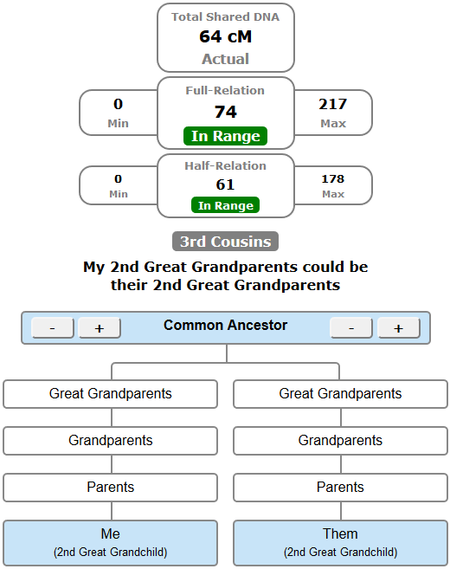
Your relationship could be a half-relation, which accounts for less shared DNA. That means you and your relative descend from just one common ancestor (e.g., one father and different mothers).
Click the Show Notes checkbox to display a note field in each tree node, where you can enter your own text. As you adjust the tree, you can fill in surnames to keep the generations straight. Include dates of an ancestor's birth or marriage to help you approximately "align" the generations between each branch of the tree.
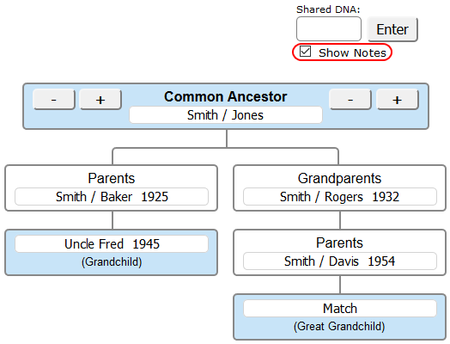
Caution: Note fields are not automatically saved. If you refresh the browser, or leave the page and come back, your previous notes are lost. To save your work click Save or Restore (below). Enter a name and click the Save button to download a copy of your work. Later, select a file you previously downloaded, then click Load to restore your work.
Hint: Use your Internet browser's Print command to print your work, or save it to a Portable Document File (PDF). (Support varies by browser. You may need to adjust the print scale or margins.)
Hide
Save or Restore
Hide

Revised: October 11, 2024
Copyright © 2018-2024 Mike Voisin. Some rights reserved.
DNA Cousin Quest is licensed by Mike Voisin under a Creative Commons Attribution-NonCommercial-ShareAlike 4.0 International License.
Contact: Mike Voisin.
Attributions:
Data courtesy of the
Shared cM Project,
Blaine T. Bettinger (www.TheGeneticGenealogist.com),
March 2020 revision.
Family Tree CSS styling adapted from Ilya Pestov.
Icons courtesy of icons-land and
FatCow.
